In February 2026, Italy hosted one of the most geographically spread-out Winter Olympic Games in history. While Milan and Cortina d’Ampezzo were the official host cities, competitions took place across northern Italy, from the fashion capital of Milan to the dramatic peaks of the Dolomites and lesser-known alpine towns tucked deep in the mountains. Together, these destinations showcased Italy’s storied winter sports history, alpine culture, and incredible variety of terrain, and every one of them makes a great winter trip now that the Games are over. Here’s a closer look at the destinations that hosted the 2026 Winter Olympics, and why they’re worth a visit.
2026 Winter Olympics Destinations
Milan: The Gateway to the Italian Alps
Milan (Milano in Italian) isn’t thought of as a winter destination in the same way as the mountain venues. Rather, it serves as a hub and entry point, with Milano Malpensa Airport (MXP) one of Italy’s busiest gateways and a natural starting point for ski trips across the Alps. Piani di Bobbio is among the closest ski areas to Milan, just over an hour away, while the bigger mountain destinations are farther afield. Milan hosted the Opening Ceremony at San Siro, as well as indoor events including figure skating, speed skating, and ice hockey. For a winter trip to Italy, we recommend spending a couple of nights in Milan at the start or end of your trip.
Note: Most of the 2026 Winter Olympics mountain venues are a few hours’ drive from Milan.

Cortina d’Ampezzo
Cortina d’Ampezzo has a rich Winter Olympics history, having first hosted the Games in 1956. In 2026, it hosted the women’s Alpine skiing events, including downhill, super-G, giant slalom, and slalom, which suit Cortina’s steep pitches and long tradition of World Cup racing. Cortina was also home to the sliding sports, bobsled, skeleton, and luge, as well as curling.
Beyond its world-renowned ski slopes, Cortina d’Ampezzo is home to a charming town full of chic cafés, amazing restaurants, bars, and boutiques. Incredible winter adventures await off the slopes, too, like snowshoeing in the Dolomites and ice climbing on frozen waterfalls. Cortina d’Ampezzo is truly a winter wonderland, and in 2024 it made Time‘s list of the World’s Greatest Places.

Livigno
Livigno, known for its high altitude, reliable snow, and lively après-ski scene, hosted the Olympic freestyle skiing and snowboarding events, from halfpipe and slopestyle to big air, moguls, and aerials. Athletes competed at the renowned Livigno Snow Park and a new aerials and moguls venue, fitting for a town with a reputation as a hub for world-class park riding and progressive freestyle culture.
Visitors love Livigno’s lively alpine atmosphere, with a pedestrian-friendly village full of dining and drink options and duty-free shopping. On the mountain, there’s plenty of terrain for skiing and snowboarding, and nearby there are guided backcountry tours and snowshoeing across wide-open landscapes. Livigno is also a great pick for a budget-friendly European ski vacation; The Telegraph has touted it as having some of the cheapest skiing in Italy.

Tesero and Val di Fiemme
The Olympic cross-country skiing events took place in Tesero, in Trentino’s Val di Fiemme, with ski jumping and Nordic combined nearby in Predazzo. Tesero is a quieter, more traditional winter destination, perfect for visitors who want a laid-back trip. It offers a slower rhythm than the larger alpine hubs, with postcard-worthy villages, family-run inns, and a deep connection to mountain culture. The Nordic trails here are some of the most scenic in Italy, winding through forests, meadows, and gentle valleys.

Tesero is steeped in alpine charm. Go cross-country skiing on one of the area’s many scenic loops or enjoy a horse-drawn sleigh ride before browsing local artisan shops. It’s the kind of place where mornings begin with crisp air on quiet trails and evenings are spent lingering over hearty Trentino dishes and local wine in family-run restaurants. Tesero may not have the flash of the bigger resorts, but that’s exactly why so many visitors fall in love with it.
Bormio
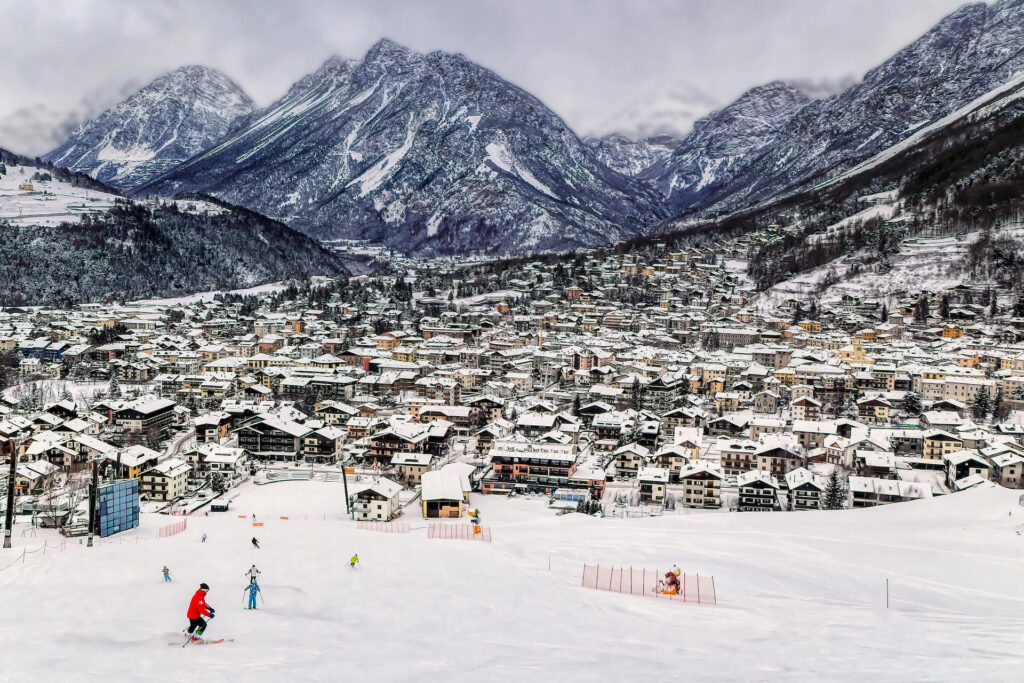
Bormio’s famed Stelvio piste hosted the men’s Alpine skiing events at the 2026 Winter Olympics. With a vertical drop of more than 3,300 feet, the Stelvio is one of the most technical and demanding downhill courses in the world. It hosted the Alpine World Ski Championships in 1985 and 2005 and is a regular stop on the men’s World Cup downhill circuit. Bormio also hosted the Olympic debut of ski mountaineering.
Winter adventures abound in Bormio, from rugged freeride and backcountry routes to snowshoe trails through larch forests. After a day in the snow, head back to the welcoming medieval town center for dinner at one of Bormio’s family-run restaurants, then soak in one of the town’s famous thermal baths, fed by natural hot springs. Long before Bormio was a famous ski destination, it was known for its therapeutic thermal waters, and there’s no better way to cap off a day in the mountains.

Anterselva
A biathlon powerhouse, Anterselva is the smallest of the Olympic destinations but one of the most scenic. The Anterselva Biathlon Arena, set high in the Alps near the Italy-Austria border, hosted the entire Olympic biathlon program. Since 1971, it has welcomed countless World Cups and several Biathlon World Championships, drawing athletes and spectators from around the world.
Beyond the stadium, visitors can soak up the serene beauty of the Antholz Valley. Snow-covered forests, frozen lakes, and towering peaks offer endless opportunities for winter exploration, from cross-country touring to peaceful snowshoe walks and scenic valley-floor hikes. The nearby villages offer a warm South Tyrolean welcome, with cozy alpine inns, traditional cuisine, and a blend of Italian and Austrian cultures that makes the region uniquely inviting.